Astrology is often misunderstood as fatalism or simple zodiac personality analysis. In reality, it is a symbolic system of correspondence between the cosmos and the individual, whose core consists of the four elements, twelve houses, and planetary dignity and debility. Understanding these three is like holding the key to interpreting your birth chart. This article systematically outlines the three pillars of astrology from the ground up.
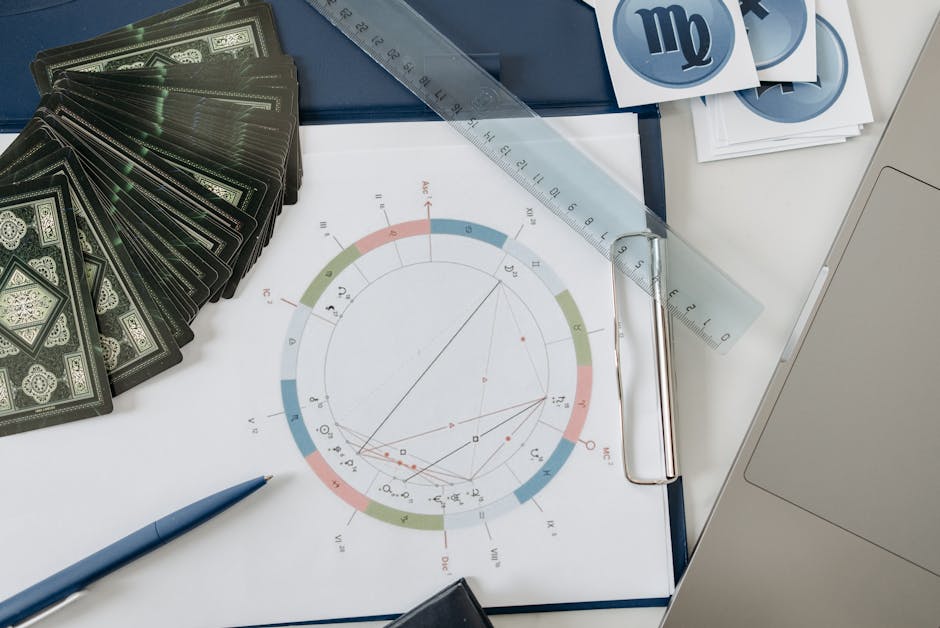
The Four Elements: Basic Tones of Energy
The twelve zodiac signs are grouped into four elements based on their essential energy: fire, earth, air, and water. Each element represents a fundamental life drive and way of perceiving the world.
Fire Signs (Aries, Leo, Sagittarius)
Fire represents passion, action, and faith. Fire signs are typically confident, idealistic, and inspiring. They focus on the future and possibilities but may lack patience and attention to detail.
Earth Signs (Taurus, Virgo, Capricorn)
Earth represents reality, stability, and the material world. Earth signs are practical, reliable, and value security and tangible results. They excel at bringing ideas to fruition but can be overly conservative or stubborn.
Air Signs (Gemini, Libra, Aquarius)
Air represents reason, communication, and ideas. Air signs are thoughtful, communicative, and concerned with relationships and fairness. They view issues objectively and with balance but may come across as detached or indecisive.
Water Signs (Cancer, Scorpio, Pisces)
Water represents emotion, intuition, and the subconscious. Water signs are sensitive, compassionate, and value emotional connection. They understand others deeply but can be overly emotional or lack boundaries.
Additionally, fire and air are considered yang (extroverted, active), while earth and water are yin (introverted, passive). Understanding the distribution of elements can quickly reveal a person's basic temperament.
The Three Modalities: Rhythms of Action
Beyond elements, signs are also divided into three modalities: cardinal, fixed, and mutable. They describe the style and rhythm of action.
- Cardinal Signs (Aries, Cancer, Libra, Capricorn): Initiators, good at starting new things, proactive.
- Fixed Signs (Taurus, Leo, Scorpio, Aquarius): Maintainers, stable, enduring, resistant to change.
- Mutable Signs (Gemini, Virgo, Sagittarius, Pisces): Adaptors, flexible, versatile, good at adjusting.
A classic analogy: when encountering a roadblock while driving, cardinal signs charge straight through, fixed signs stop to solve it slowly, and mutable signs find a detour. None is better or worse; they are simply different coping strategies.
The Twelve Houses: Twelve Areas of Life
If signs represent energy and traits, houses represent the specific areas of life where these energies are applied. Houses are divided from the ascendant, each spanning 30 degrees, for a total of 12 houses.

- First House (House of Self): Self, appearance, personality. The ascendant point, representing the first impression you give the world.
- Second House (House of Possessions): Money, resources, values. Reflects your material foundation and sense of security.
- Third House (House of Communication): Communication, learning, siblings. Represents daily exchanges, short trips, and basic education.
- Fourth House (House of Home): Family, roots, later life. Symbolizes the family of origin, ancestral karma, and inner security. When transits activate the fourth house, it often accompanies family events or the revelation of secrets.
- Fifth House (House of Pleasure): Romance, creativity, entertainment. Represents love affairs, artistic creation, children, and adventure.
- Sixth House (House of Health): Work, health, daily routine. Reflects daily work, service to others, physical care, and pets.
- Seventh House (House of Partnership): Partners, cooperation, open enemies. Represents marriage, business partnerships, and one-on-one interactions.
- Eighth House (House of Transformation): Inheritance, sex, transformation. Involves deep resources, death and rebirth, psychological shadows.
- Ninth House (House of Philosophy): Higher education, travel, philosophy. Represents long journeys, faith, and the pursuit of wisdom.
- Tenth House (House of Career): Career, reputation, social status. Represents professional life, public image, and achievements.
- Eleventh House (House of Friendships): Friends, groups, ideals. Represents social circles, community involvement, and long-term goals.
- Twelfth House (House of the Subconscious): Subconscious, hidden matters, spirituality. Represents solitude, secrets, karmic patterns, and inner healing.
The first and tenth houses are two focal points of the chart, representing "who I am" and "how I am recognized by the world." The fourth house carries the foundation of the family and is key to understanding the influence of one's family of origin.
Planetary Dignity and Debility: The Quality of Power
In traditional astrology, planets do not exert their influence equally. When they fall into different signs, they exhibit dignity (strength) or debility (weakness). This is the core logic for assessing the strength of energy in a chart.
Essential Dignity and Essential Debility
Essential dignity refers to a planet being in its own sign or exaltation, such as the Sun in Aries (exaltation) or the Moon in Cancer (rulership). In such cases, the planet can express its qualities naturally and smoothly, as if endowed with talent. Essential debility is the opposite, such as the Sun in Libra (fall) or Jupiter in Capricorn (fall), where the planet struggles to manifest its nature and requires extra effort.
Accidental Dignity and Accidental Debility
Accidental dignity refers to a planet receiving favorable external conditions, such as being in a good house (1st, 4th, 7th, 10th) or supported by benefic planets. Accidental debility means the planet is in a difficult house (6th, 8th, 12th) or in hard aspect with malefics. Even if a planet is essentially dignified, accidental debility can suppress its energy.
When interpreting a chart, a comprehensive assessment is needed. For example, the Sun in Aries (essential dignity) but in the twelfth house (accidental debility) suggests a person is naturally confident but may struggle to express themselves due to environmental constraints. Conversely, the Sun in Libra (essential debility) but in the tenth house (accidental dignity) may achieve recognition in career through effort.
Understanding dignity and debility is the foundation for accurate prediction. For instance, in transits or solar returns, if a planet has both essential and accidental dignity, positive events are more likely; if both are debilitated, challenges should be anticipated.

Further Reading
Frequently Asked Questions
Which is more important: the four elements or the houses?
Both are equally important, but they operate on different levels. The four elements describe the nature of energy (e.g., passionate, practical), while the houses describe the areas of life where that energy is applied (e.g., career, family). When interpreting a chart, they must be combined: for example, Mars (action) in the fourth house (home) may indicate action and conflict in family matters.
Are planetary dignity and debility fixed?
In traditional astrology, essential dignity and debility are fixed, based on the natural relationship between planets and signs. However, accidental dignity and debility change over time and with transits. For example, transiting Jupiter entering your tenth house (accidental dignity) may bring career luck. Thus, dignity and debility are part of a dynamic assessment.
Can I see houses without a birth time?
No. House calculation requires an accurate birth time (within at least 15 minutes), as houses are based on the Earth's rotation and the horizon. Without a time, you can only look at planetary sign placements and aspects, but house information will be missing. It is recommended to obtain an accurate birth time or use a birth time rectification service.
If you are curious about your own chart, try our online chart tool by entering your birth information to see your element distribution, house placements, and planetary dignity. For more astrology knowledge, feel free to browse other articles on Astrology Insights.
