Seven of Swords
Seven of Swords meaning: deception, strategy and getting away with it. Upright & reversed readings for love, career and finance.
Imagery & Core Meaning
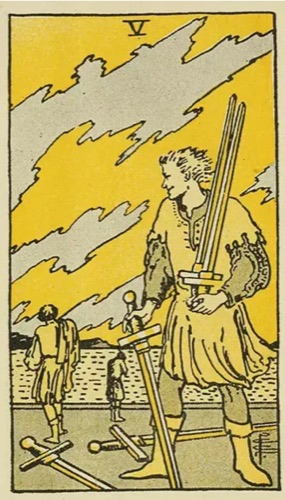
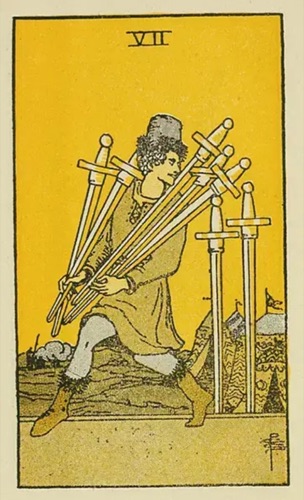
A man tiptoes from a military camp clutching five swords, glancing back, two left in the ground, the soldiers unaware. His look mixes a thief's glee with unease — you can carry five, never all seven.
Among the tarot's most nuanced cards: deception and corner-cutting, but also strategy and the wisdom of not fighting head-on. The question is whether the detour is tactics or a shortcut you'll repay.
▲ Seven of Swords Upright Meaning
Upright points one of two ways. First: strategy over force — sidestepping confrontation, keeping cards close, advancing alone — often the smart play in complex situations.
Second: something is not fully honest — someone, possibly you, is concealing or operating in a gray zone. The two swords left behind warn that even careful schemes miss something.
💞 Love
Watch for incomplete candor: hiding, ambiguity, or games replacing honest talk. A gentler reading is a planned surprise — ask whether daylight brings delight or hurt.
💼 Career
Finesse over force: independent work, routing around bureaucracy, keeping your plan private. But watch for credit-grabbing and withheld information; keep important matters in writing.
💰 Money
Cunning and risk together: unconventional strategies may open doors, but distrust shady 'insider tips' and buried clauses. Deals demanding fast signatures deserve more questions.
▽ Seven of Swords Reversed Meaning
Reversed, truth surfaces: a concealment exposed, a lie unsustainable, or a secret grown too heavy. Lifting the lid yourself costs far less than exposure.
Or a scheme fails and conscience returns: the shortcut has run out, walk the straight path; or you see some 'cleverness' was self-deception, and dropping it brings relief.
💞 Love
Secrets may surface or be confessed: shaking short-term, trust-building long-term. Or you drop the games and speak plainly — which usually works better anyway.
💼 Career
Maneuvering may be exposed, or corner-cutting proves untenable and you choose to compete on merit. Asking for help may open doors solo stealth cannot.
💰 Money
Gray-area risks near their reckoning, or an avoided money matter demands daylight. Voluntarily correcting errors costs less than waiting for the blowup.
✦ Advice from This Card
Learn the difference between strategy and self-deception. If the detour spares real friction, use it boldly; if it hides fear, the road collapses. Secrets told by you always beat exposure.
❓ FAQ
Is the Seven of Swords a yes or no card?
Cautiously neutral rather than yes. Achievable, but the method decides — strategy may succeed, while concealment leaves hidden costs.
Does the Seven of Swords in love mean cheating?
Not automatically, but it flags incomplete honesty: concealment, ambiguity or games. Surrounding cards show severity — it can even mean a harmless surprise.
Does a reversed Seven of Swords mean exposure?
Often, yes — but it has a bright side: voluntary confession, abandoning shortcuts, ending self-deception. Revealing it yourself always beats being found out.