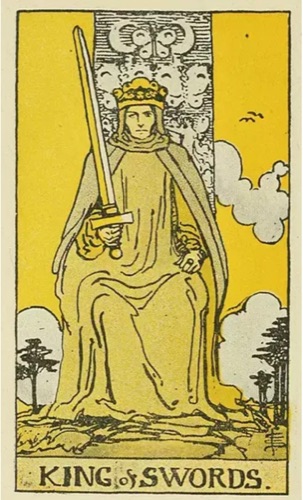
King of Swords
King of Swords meaning explained: intellectual authority and fair judgment upright; manipulation and misuse of power reversed. Love, career, finance.
Imagery & Core Meaning
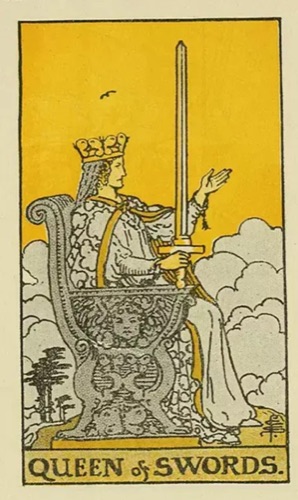
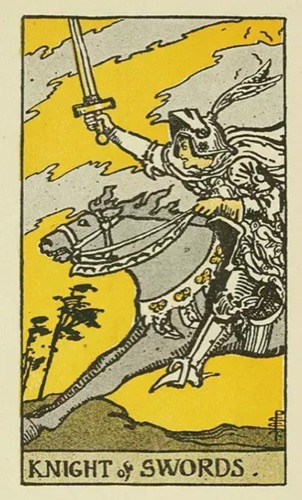
In the Rider-Waite image, a king sits bolt upright on his throne, sword held at a slight angle in his right hand, eyes level, expression permitting no ambiguity. Butterflies and crescent moons are carved into the throne's back; behind him the sky is clear blue with low clouds. Unlike the charging knight, his power is still: he doesn't draw the blade to chase anyone, because he is the one who writes the rules.
The core energy of the King of Swords is reason in its highest form: clean logic, impartial judgment, authority anchored in principle and truth. As the mature, mastered fire of Air, he stands for intellect wholly in service of a larger aim — the judge, the strategist, the leader whose word is law because it is right. His sword symbolizes not attack but discernment: cutting cleanly between true and false, essential and trivial.
▲ King of Swords Upright Meaning
Upright, the King of Swords marks a period ruled by reason and principle: you rise above the emotional whirlpool, analyze in structured terms, and reach decisions that survive scrutiny. The card urges you to step into the judge's seat — set the standard clearly, then hold it consistently.
It can also represent such an authority figure near you: a mentor, lawyer, doctor, executive — someone known for competence and fairness. Respect professional counsel, and examine yourself in parallel: in your own field, are you becoming the person who both decides and decides correctly?
💞 Love
In love, the upright King shows a relationship run on maturity and candor: clear commitments, explicit boundaries, problems reasoned through rather than frozen over. Its short side is warmth — love can't run on logic alone, so leave room for clumsy but sincere expression. If single, you're drawn to partners who meet you at eye level intellectually.
💼 Career
At work, this is a strong card of leadership and professional authority: ideal for setting policy, making the final call, and handling complex matters that demand objectivity. Your analytical power and credibility are at a high, and people will lean on your rulings. Stay impartial, and that trust compounds.
💰 Money
Financially, the upright King means disciplined money management: allocate by principle, execute by plan, don't be swayed by market mood. For contracts, legal documents, or major transactions, review every clause and consult professionals where needed — procedural rigor protects your actual interests.
▽ King of Swords Reversed Meaning
Reversed, the King of Swords is reason decayed into tactics: using cleverness to manipulate, wielding rules as weapons, practicing arbitrariness under the flag of objectivity. It can be an authority abusing power — the blade no longer separates right from wrong but suppresses dissent.
Alternatively it shows judgment breaking down: indecision, muddled logic, or choices made under pressure that betray your own principles. The card asks you to recalibrate your inner code: power and intelligence have no direction of their own — the hand on the sword decides what they serve.
💞 Love
Reversed in love, watch for cold-shoulder punishment, gaslighting, or a suffocating dynamic where one side is always 'right': all the reason on his side, all your feelings ruled inadmissible. If you're chronically doubting yourself in a relationship, that's not you being irrational — it's reason being weaponized.
💼 Career
At work, the reversal flags two risks: you may face an autocratic, scheming boss or partner — keep written records and hold your boundaries; or you yourself may be hardening into severity under pressure. Power is the best developer fluid there is — don't let it reveal a picture you dislike.
💰 Money
Financially, the reversed King warns against the 'clever person's trap': scams wrapped in airtight logic, overconfident leverage, or edging into grey zones for a shortcut. Any plan that sounds flawless deserves one more pass through plain common sense.
✦ Advice from This Card
The King of Swords advises you: be the person who both holds the sword and deserves it. Exhaust the facts before judging; own the consequences after ruling. Hold principles with the strong and leave mercy for the weak. Real authority needs no volume — it comes from one thing: your standard applies to everyone equally, starting with yourself. Keep that, and your yes and your no will both carry weight.
❓ FAQ
Is the King of Swords a yes or no card?
He answers like a judge: yes if the case is proven, no if it isn't. Strip the question of wishful thinking and examine the evidence — if the facts hold up, proceed with confidence; if you're rationalizing, the gavel comes down on no.
What kind of person does the King of Swords represent?
Usually a rational, fair, authoritative mature man — or anyone carrying that energy: rigorous logic, word kept, leading through principle and competence. Judges, lawyers, executives, advisors. The shadow is coldness and tyranny.
What does the King of Swords mean in a love reading?
A relationship heavy on the rational side: clear commitments, logical communication, explicit rules of engagement. It affirms that maturity while reminding you love needs warmth beyond logic. In a difficult spread, it can flag one partner dominating through being perpetually 'right.'